
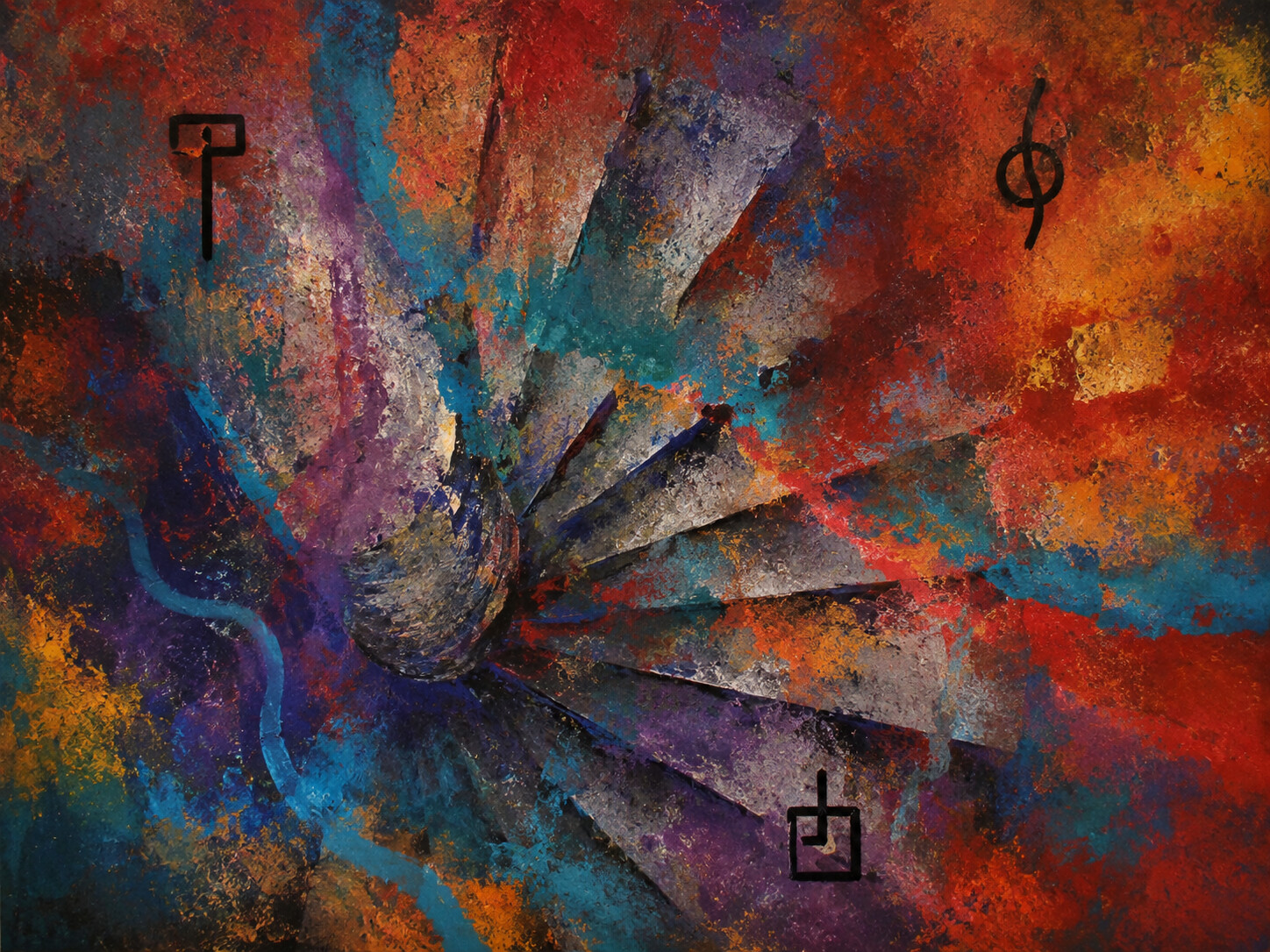
Darkness in the New Work of Jan de Flaubert
The word dark immediately suggests black, obscurity, death, the macabre or horror. Yet a work can be profoundly dark without using a dark palette, depicting violence or relying on the familiar imagery of the gothic or fantastic. Much of my recent digital painting occupies precisely this territory.
Reds can be brilliant, blues intense, violets deep and oranges almost luminous. Colour does not need to disappear for an image to become unsettling. On the contrary, I am interested in the idea of a light that does not reassure. Darkness then becomes less a colour than a relationship with reality.
My paintings often contain something immediately recognizable: a face, a tree, a house, a staircase, a chair or a guitar. But that element is never entirely at home. It appears within pictorial matter that crosses it, fragments it or begins to absorb it. A line may divide the space without telling us whether it is a boundary, a current or a fracture. Signs appear but deliver no message. Certain empty areas attract the eye while refusing to become a stable centre.
Reality remains visible, but it is no longer completely secure. Perhaps this is where darkness begins for me: not in the explicit representation of something frightening, but in the feeling that what we see does not exhaust what is there.
Goya’s Black Paintings represent almost the opposite approach. Their darkness belongs both to their pigments and to the sombre nature of their subjects. What interests me is less their literal darkness than their ability to destabilize the visible world. My own movement is almost reversed: to preserve uncertainty while allowing intense colour and light to remain.
With Odilon Redon, the connection is different. Symbolism privileged subjective experience, suggestion and ideas over objective representation, while Redon repeatedly explored dreams and realities inaccessible to ordinary sight. In my work, however, the invisible rarely emerges from blackness. It appears behind colour. It does not necessarily take the form of a creature or vision. Something simply remains unexplained.
Edvard Munch similarly allowed the boundary between external and internal reality to become unstable. In works such as The Scream, colour and undulating lines make the landscape participate in psychological experience. My paintings are generally less directly expressionistic. A face may be grave without suffering. A house may become unsettling without anything dramatic occurring inside it. An empty chair may become a presence without telling us who is absent.
Ambiguity interests me more than confession.
Anselm Kiefer offers another form of darkness through physical matter, historical memory and materials such as lead, straw, ash, soil and sand. My recent work begins in an almost opposite medium: the digital image, which initially possesses neither weight nor physical thickness. And yet I constantly search for matter.
Rough surfaces, layers, erasures, traces and fractures allow the digital image to regain a pictorial density. Printing the work on canvas can then return that image to physical space.
Darkness also exists outside painting.
Scriabin’s Vers la flamme, which I recently used in my video Paintings in Transformation, moves through an extraordinary continuous escalation towards musical incandescence. Here darkness is neither quiet nor necessarily low or sombre. It can burn. It can become luminous precisely when tension reaches its highest point.
That is very close to what I seek through colour: light itself can become unsettling. Several elements have gradually become recurrent in my work: presence, fracture, emptiness and signs.
A figure emerges without fully separating itself from the pictorial matter.
A fracture interrupts the continuity of the image.
An empty space seems to contain nothing and yet attracts the eye.
Signs appear as fragments of a language without translation.
None of these elements explains the work.
They do the opposite.
They keep it open.
I am therefore not particularly interested in producing “Dark Art” as a genre whose conventions should be followed.
I am interested in making images in which the visible world remains incomplete.
A painting may be beautiful, colourful, luminous and even seductive while still containing a fissure.
Something no longer entirely corresponds to what we thought we recognized.
Perhaps that is where my own relationship with darkness lies.
I paint what appears between the visible and what escapes it.
No responses yet