
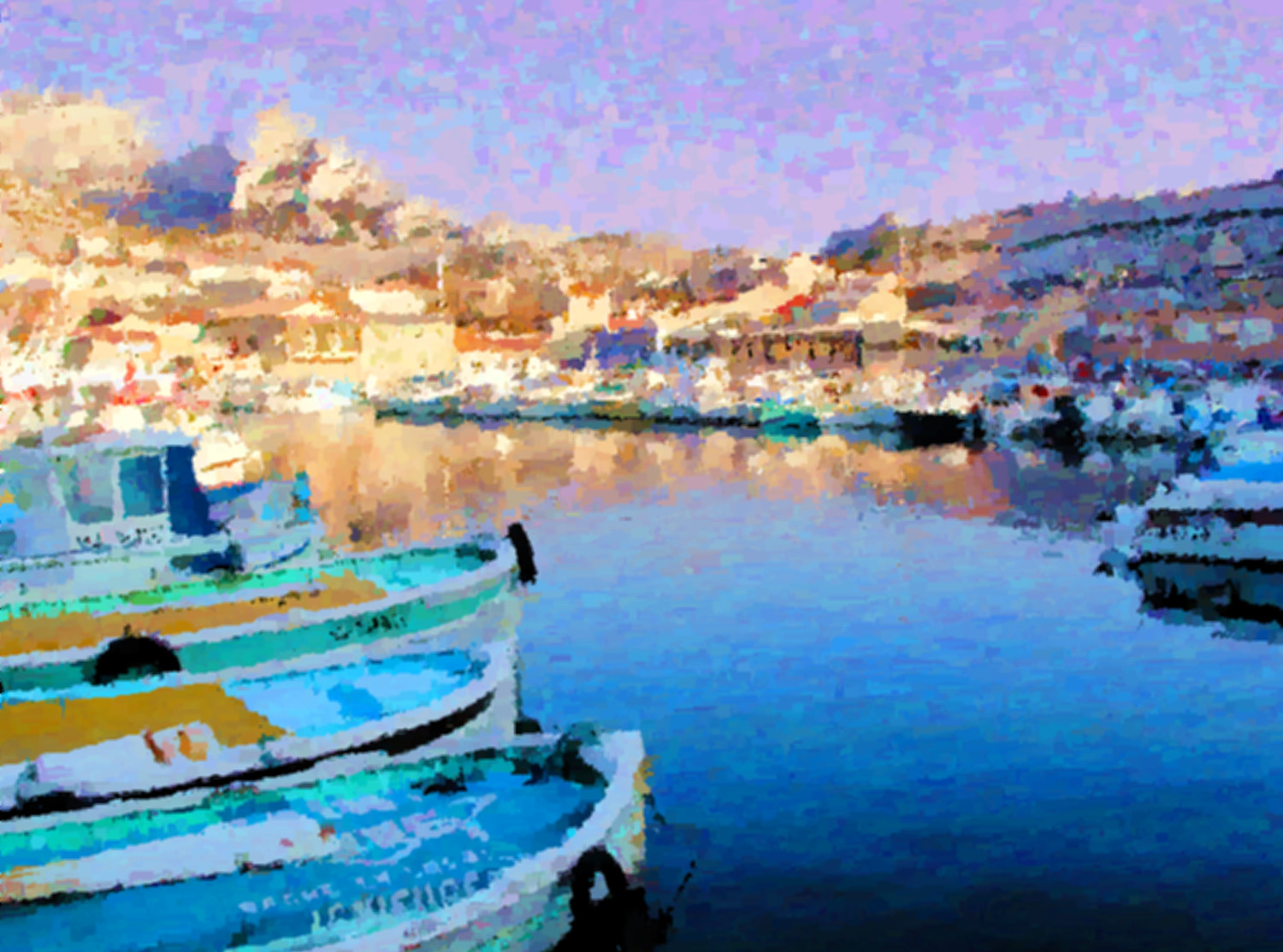
For a long time, digital tools were already present at the beginning of my creative process.
Before painting on canvas, I created studies on a computer. I used programs such as Krita on Linux to search for a composition, move shapes, work on colours and gradually build an image that would later become the starting point for a physical painting.
I often compared this method to the way earlier painters prepared studies before transferring an image to canvas or wall.
The computer was therefore never, for me, a world opposed to painting. It was simply a preparatory studio.
Then something changed.
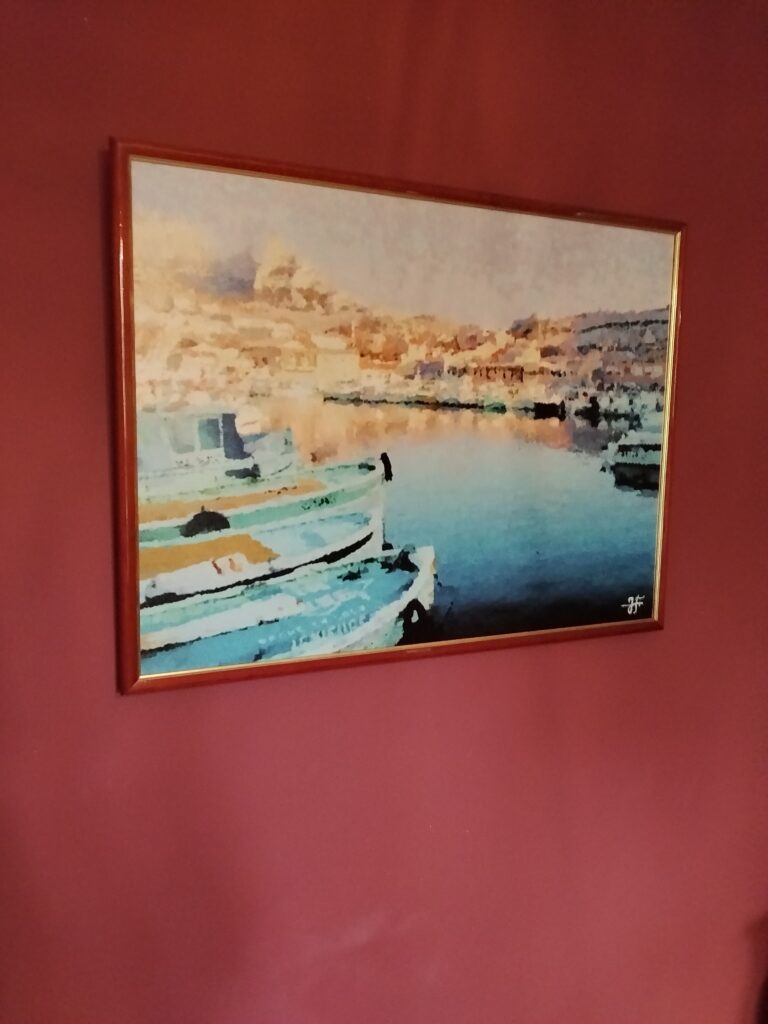
Over time, I began to realize that some digital images no longer needed to become something else. They possessed an existence of their own. Systematically turning them into projects for physical canvases did not necessarily add anything; sometimes it even meant abandoning possibilities that had appeared precisely because the work was digital. But my interest in entirely digital creation goes back a long way. In 1999, after photographing the small port of Goudes in Marseille with a film camera, I had a photograph developed and then digitized and transformed into a work intended for printing on canvas to paint. The file, entrusted on CD to the only Marseille printer offering this process, is printed in 25P format. The work still hangs in my home.
But my interest in entirely digital creation goes back a long way. In 1999, after photographing the small port of Goudes in Marseille with a film camera, I had a photograph developed and then digitized and transformed into a work intended for printing on canvas to paint. The file, entrusted on CD to the only Marseille printer offering this process, is printed in 25P format. The work still hangs in my home.
I therefore began to consider the digital image not as a study, but as a finished work.
The consequences were greater than I expected.
It was not simply a question of replacing brushes with a screen. Digital work allowed me to shift the boundaries of the work itself.
My earlier abstract paintings already contained the elements that remain familiar to me: intense colour, texture, signs, lines and shapes that resist identification. But once I began to work fully within the digital space, figurative presences could enter this universe much more freely.
Faces, bodies, trees, houses, staircases, chairs, lamps and other ordinary objects began to appear.
I did not want them to become illustrations placed in front of an abstract background.
They had to belong to the painting.
A face had to be able to emerge from the pictorial matter or disappear into it. A tree could become almost an organic fracture. An empty chair could become a presence through absence. A staircase no longer needed to lead to another floor; it could lead towards a space about which we know nothing.
This is probably where my present work truly began.
Today I use several kinds of tools: digital painting, image editing and transformation and, when I find it useful, AI-assisted generation.
I often work from my own earlier paintings in order to preserve my pictorial vocabulary. I also use photographs when I need a specific face, body, object or architectural form.
I produce trial versions, discard them, and start over; I alter color relationships, the placement of a figure, its dissolution into the background, the density of the material, the signs, the lines, or the fractures. An initial image is generally nothing more than a proposal. It often takes several versions and various corrections before something emerges that truly corresponds to what I am looking for.
In that sense, the process is not so different from painting.
When I worked on canvas, I could repaint an area repeatedly until it felt right. Today the gestures are different, but the principle remains the same: I recognize the image when I finally reach the one I had been searching for.
Digital work also allows me to work more rapidly and to explore far more directions. This does not mean that every image produced becomes a work of art. Quite the opposite: greater quantity makes selection even more important.
Nor do I wish to erase the history of my paintings on canvas. They are the source of what I am doing now. The colours, textures, signs and perhaps even the way I construct space all come from that earlier practice.
I therefore see this change less as a break than as a displacement.
The medium has changed.
The working space has expanded.
But I am still looking for the same thing: an image that I recognize without being able to explain it completely.
An image behind which something seems to remain.
No responses yet