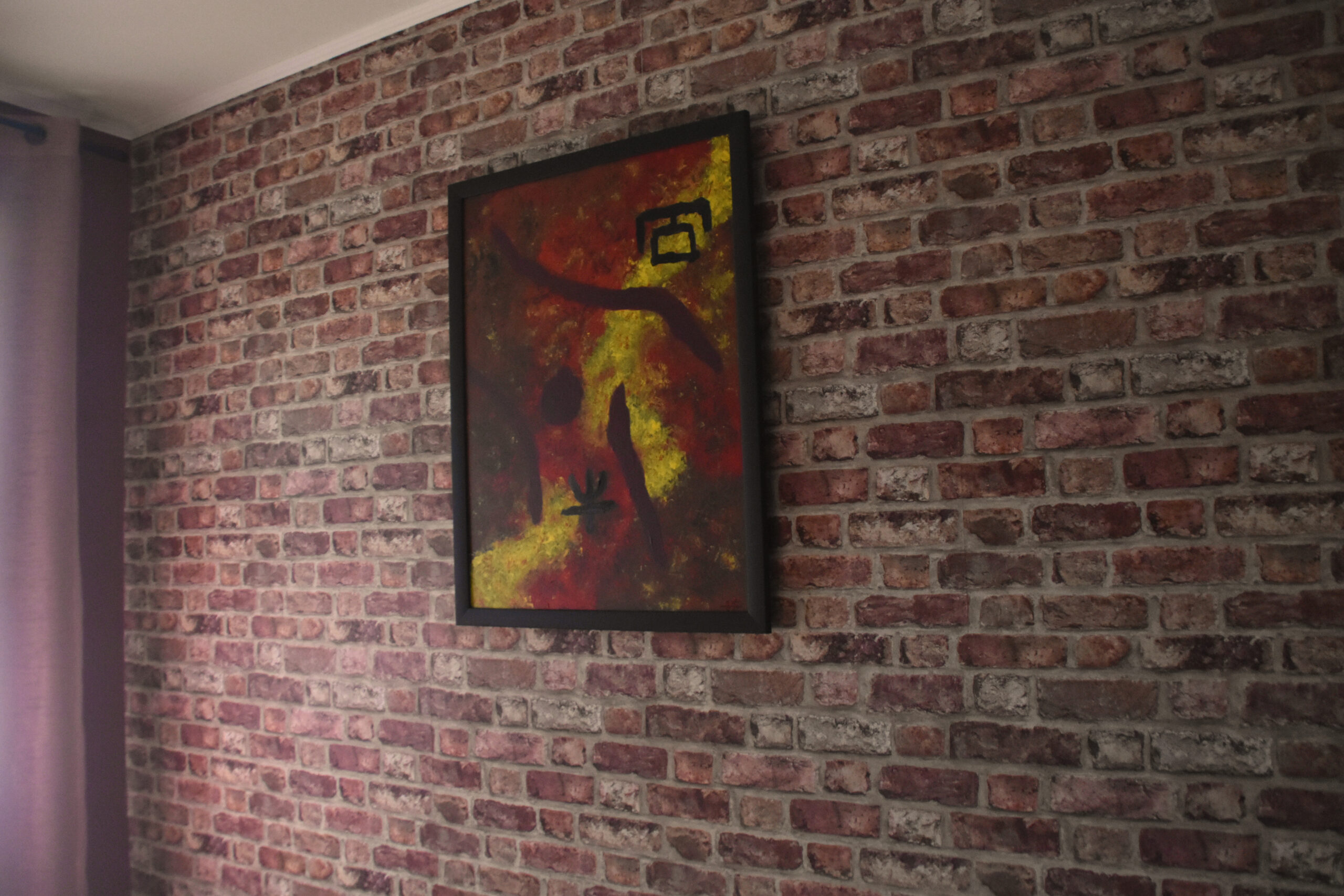
Between the Visible and the Invisible
I do not really try to tell stories through my paintings. I am more interested in the moment when an image stops being completely explainable.
What attracts me often lies at a threshold: between presence and absence, appearance and disappearance, depth and surface, reality and inner space. A house, a tree, a staircase, a chair or a face may remain perfectly recognizable and yet seem to belong to another order of reality. It is precisely this uncertainty that interests me.
For a long time, strange signs have appeared in my paintings. Some originate in characters I occasionally perceive when I am half asleep. Unknown forms seem to pass before my eyes like fragments of a written language whose meaning is entirely inaccessible to me. I do not try to decipher them. Sometimes one shape remains in my memory and later finds its way into a painting.
These signs therefore form no code. They do not symbolize anything definite. They remain as traces, presences, perhaps fragments of a language whose key has been lost.
The same is true of the lines, fractures, erased areas and shapes that cross my compositions. They are not there to explain the image. On the contrary, they prevent it from closing too easily around a single interpretation.
Colour is essential to my work. I can seek a grave or unsettling atmosphere without necessarily using dark colours. Reds, blues, violets, oranges and turquoise can create a kind of light that offers no reassurance. A painting may be luminous and intense while retaining something silent, uncertain and deeply inward.
My recent move towards digital painting has not changed this search. It has simply opened a wider space for it. Figures can now emerge, dissolve and merge more deeply into the pictorial matter until they become part of the landscape of the painting itself.
I do not wish to explain what my works mean.
If something exists behind their surface, I would rather leave each viewer free to encounter it for themselves.